Stone Age (Neolithic): Early Settlers
Archaeological digs along the Forth Valley have uncovered Neolithic pits, worked stone tools, and over 5,000-year-old Impressed Ware pottery.
Clackmannanshire · Scotland
Stand on King's Seat Hill and look across the landscape that has watched the Bruce family, Robert Burns and centuries of Scottish history pass by.
A medieval tower house above the Wee County
Clackmannan Tower stands proudly on King's Seat Hill, overlooking Clackmannan and the Forth Valley. The earliest part of the existing tower dates from the later 14th century, with later additions creating the distinctive L-plan building seen today.
Discover the history →02 / The story
Archaeological digs along the Forth Valley have uncovered Neolithic pits, worked stone tools, and over 5,000-year-old Impressed Ware pottery.
A ceremonial stone circle stood near Tillicoultry; Marshill burials yielded ornate urns and gold armlets.
Excavations revealed timber and turf ring-ditch roundhouses alongside fine decorated bronze axeheads.
The town takes its name from the Clach Mhanainn, a boulder sacred to sea god Manannán mac Lir.
Roman patrols monitored local tribes north of the Antonine Wall from nearby fortresses.
King's Seat Hill served as a vital eastern lookout post against invading Angles and Scots.
The hilltop operated as a crucial beacon station warning of longships sailing up the Forth.
Kings Malcolm IV and William the Lion maintained a royal timber castle and hunting seat on the ridge.
Legend says King Robert the Bruce dropped his glove (mannan) here and sent a servant to "Look about ye!".
David II granted Clackmannan to Sir Robert Bruce; builders included a secret vault for deeds.
The keep was heightened and a 5-storey south wing was added, turning it into an L-plan castle.
A basement well with a ceiling hoist hatch was cut to supply water during long sieges.
Fortified during Henry VIII's invasion campaigns, the tower monitored English naval movements.
Sir Henry Bruce authorized shallow coal pits at the base of the hill to generate estate wealth.
A grand new entrance with a classical pediment and sculpted archway was added to the East wall.
The family secretly harbored Stuart sympathies while successfully avoiding Crown land confiscations.
Lady Catherine Bruce entertained Robert Burns and playfully knighted him with Bruce’s sword.
The mansion house was demolished, leaving the original stone tower standing alone.
Coal subsidence caused an east wall collapse, leading to state stabilization and repairs.
Radar surveys confirm the complete 16th-century mansion foundation footprint remains intact under the grass.
03 / A famous visitor
On 26 August 1787, Robert Burns visited Clackmannan Tower. Lady Catherine Bruce, a descendant of Robert the Bruce, used the family's sword to perform a playful knighting ceremony.
A small Scottish tower, a famous poet, and one very memorable afternoon.
Read the Burns story ↗04 / Plan your visit
The exterior can be viewed year-round from the hilltop setting.
Interior tours are running on selected dates through 28 October 2026. Current prices are £11 adult, £9 concession and £6.50 child.
Nearest public parking is in Clackmannan village, around a half-mile walk from the tower. Strong footwear is recommended.
The approach crosses working farmland. Tours include steep stairs, uneven flooring, low lintels and exposed heights.
05 / The view
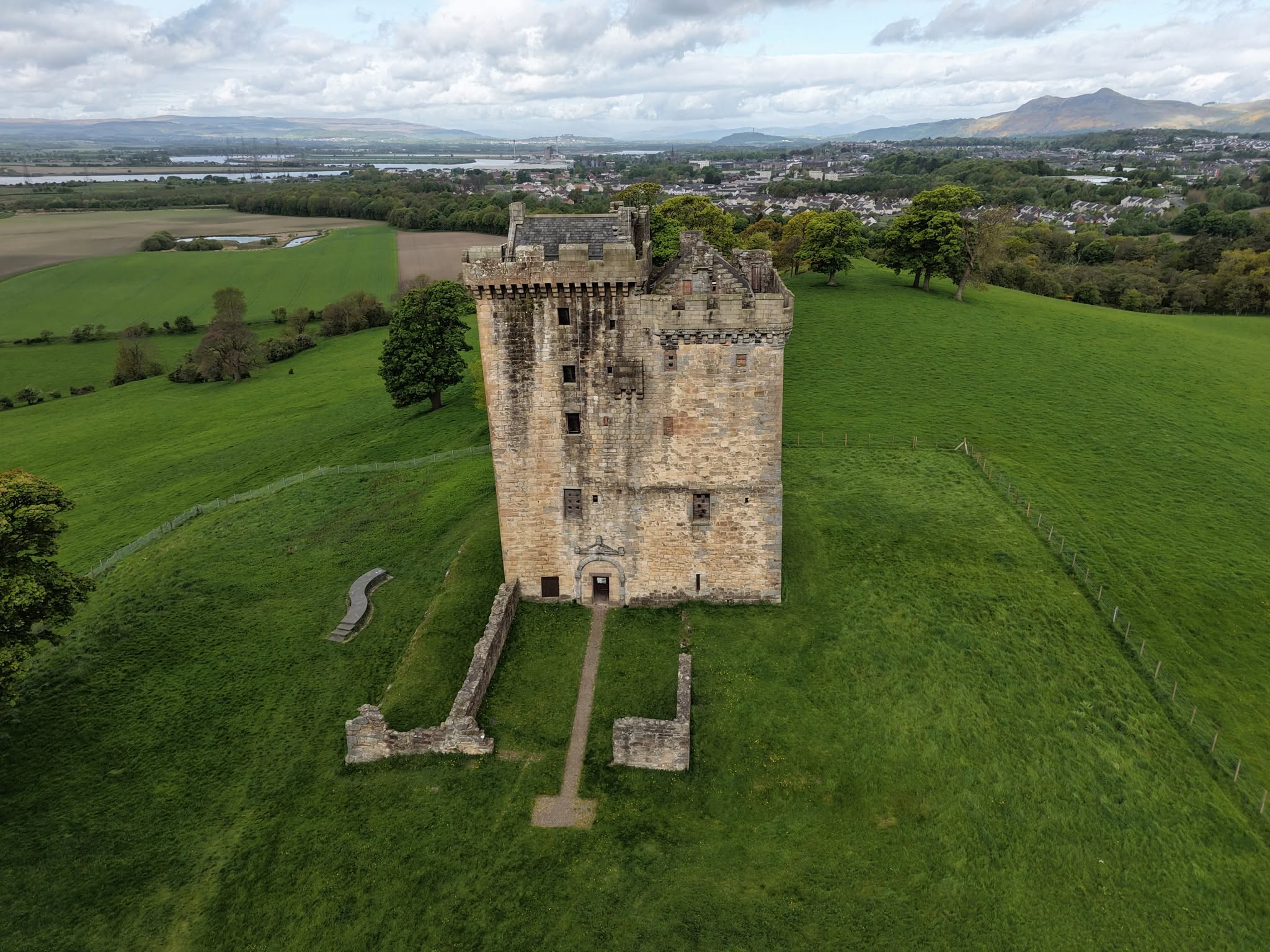
A landmark in the landscape, with views south towards the Forth and north towards the Ochil Hills.
06 / Explore further
Come and see it for yourself